Home › Industrial and Heavy-Duty Asphalt Paving
Handle heavy traffic with confidence using industrial asphalt paving in Cleveland, OH. We design thick, reinforced pavements for truck yards, loading docks, and warehouse areas. Proper base, asphalt mix, and drainage keep your surfaces strong under frequent turning and heavy loads.
Precision Asphalt Cleveland provides professional industrial asphalt paving throughout Cleveland, OH, Ohio and the surrounding area. Our licensed, insured crew delivers safe, clean, on-time work with a free estimate before anything begins. Call or request your free quote.
Industrial Asphalt Paving Built For Heavy Loads In Cleveland
Industrial and heavy-duty asphalt paving is different from paving a driveway or a small parking lot. At Precision Asphalt Cleveland, we design and build pavements that stand up to constant truck traffic, loaded forklifts, container stacking, and freeze-thaw cycles that hit the Cleveland shoreline every winter. Our focus is on structural strength, load distribution, and long-term performance, not just appearance.
Typical industrial projects we handle in Northeast Ohio include distribution centers, manufacturing plants, trucking terminals, intermodal yards, scrap and recycling facilities, waste transfer stations, and heavy equipment storage yards. Each site has its own traffic patterns and stress points, so every design is engineered, not copied from a standard template.
When you hire Precision Asphalt Cleveland, you are getting a contractor that speaks the same language as your structural engineer, facility manager, and risk manager. We match asphalt mixes, base depths, and reinforcement options to your expected axle loads, turning movements, and drainage conditions so the pavement performs as part of your overall operations plan, not as an afterthought.
How We Evaluate Your Site And Engineer A Heavy-Duty Section
Industrial asphalt paving starts with a detailed site evaluation. Our team walks the property to document soil conditions, existing pavements, drainage paths, loading dock locations, and the heaviest traffic zones. In the Cleveland area we often see clay subgrades that hold water and lose strength in spring thaws, so we plan for that from the beginning.
We analyze your actual use. How many trucks per day, what axle loads, how tight are the turning radii in truck courts, where do forklifts cross expansion joints or thresholds, will you be using seasonal outdoor storage with point loads on outriggers or jack stands. These details determine the pavement section we recommend.
From there we design the structure from the bottom up. That includes the subgrade treatment (proof rolling, undercutting soft spots, geotextile separation, stabilization if needed), aggregate base thickness and gradation, and then the asphalt lifts (base and surface courses) with specific industrial mixes. For facilities with very heavy point loads, we may recommend thicker asphalt sections or hybrid designs that combine asphalt with reinforced concrete pads at loading docks or dumpster areas.
Materials And Mixes For Industrial Asphalt Paving
Not all asphalt mixes are appropriate for heavy-duty work. Precision Asphalt Cleveland works with local plants to specify high-stability industrial asphalt mixes that hold up under slow, turning, or static loads common in truck yards and loading areas.
For heavy-duty sections we typically use a thicker asphalt base course with larger aggregate and higher asphalt binder content to create a stiff, load-bearing layer. On top of that we place a dense graded surface course that resists rutting and fuel drips. In high stress areas, like truck turnarounds and tight corners, we may specify a polymer-modified surface mix that performs better under shoving forces and temperature swings.
We also account for Cleveland's freeze-thaw cycles and use materials and gradations that limit water infiltration and resist thermal cracking. Where drainage is marginal, we may incorporate open-graded drainage layers or underdrains so water leaves the pavement structure instead of freezing within it and breaking it apart over time.
Step-By-Step: Our Heavy-Duty Paving Process
1. Investigation and layout: We verify grades, stake critical elevations for drainage, and locate utilities. On industrial projects around Cleveland this often means coordinating with multiple trades so trenches and conduit runs are complete before we build the pavement section.
2. Subgrade preparation: We strip unsuitable material, compact the native subgrade, and perform a proof roll with a loaded truck. Any areas that pump or deflect are undercut and replaced with suitable aggregate or, if necessary, stabilized with stone and fabric to achieve a firm, uniform platform.
3. Aggregate base installation: We install and compact crushed aggregate in controlled lifts, typically 4 to 6 inches at a time, to the thickness required by your design. For heavy-duty applications this base can reach 8 to 12 inches or more. We use laser-guided or GPS-guided grading equipment on large sites to maintain consistent thickness and cross slope.
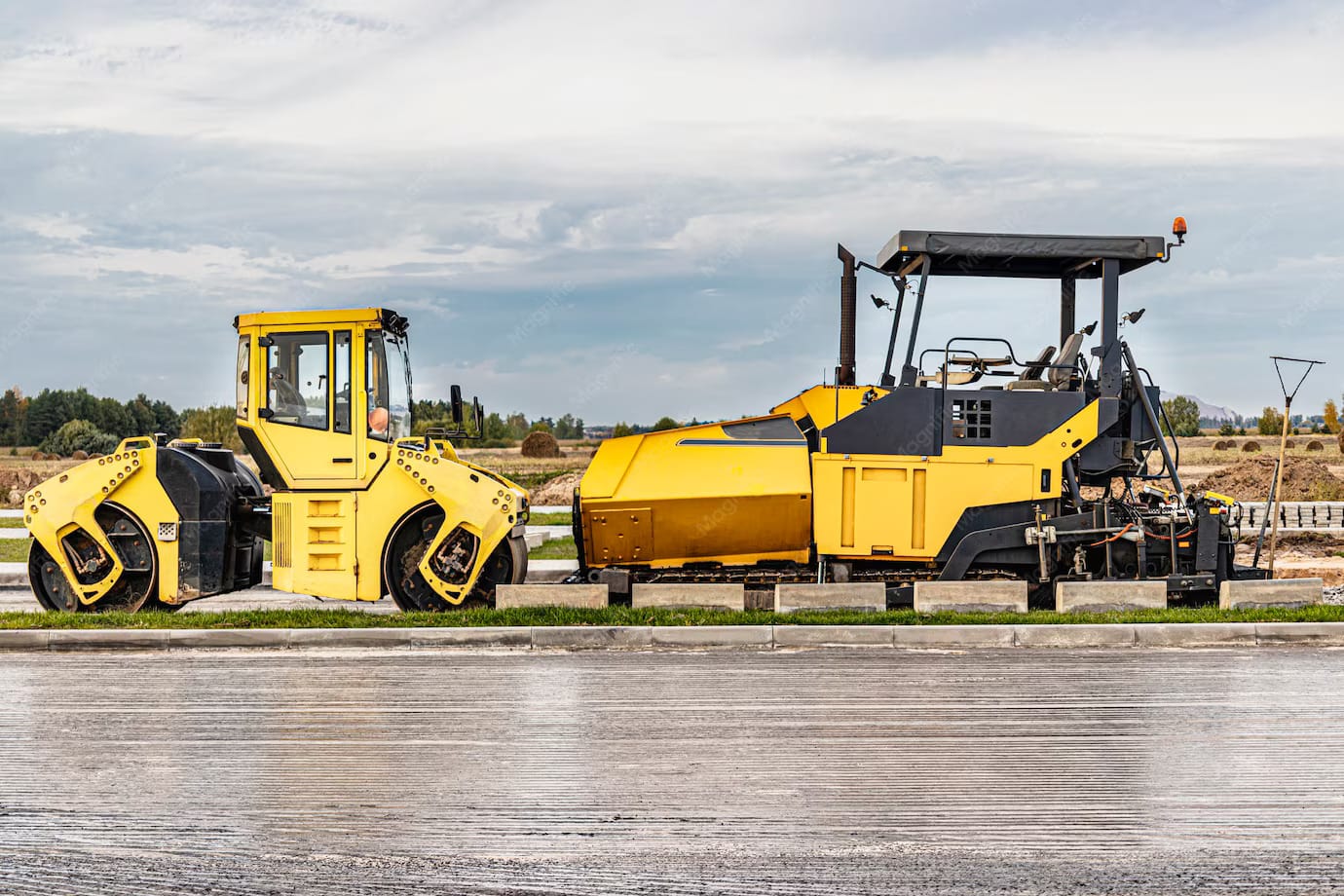
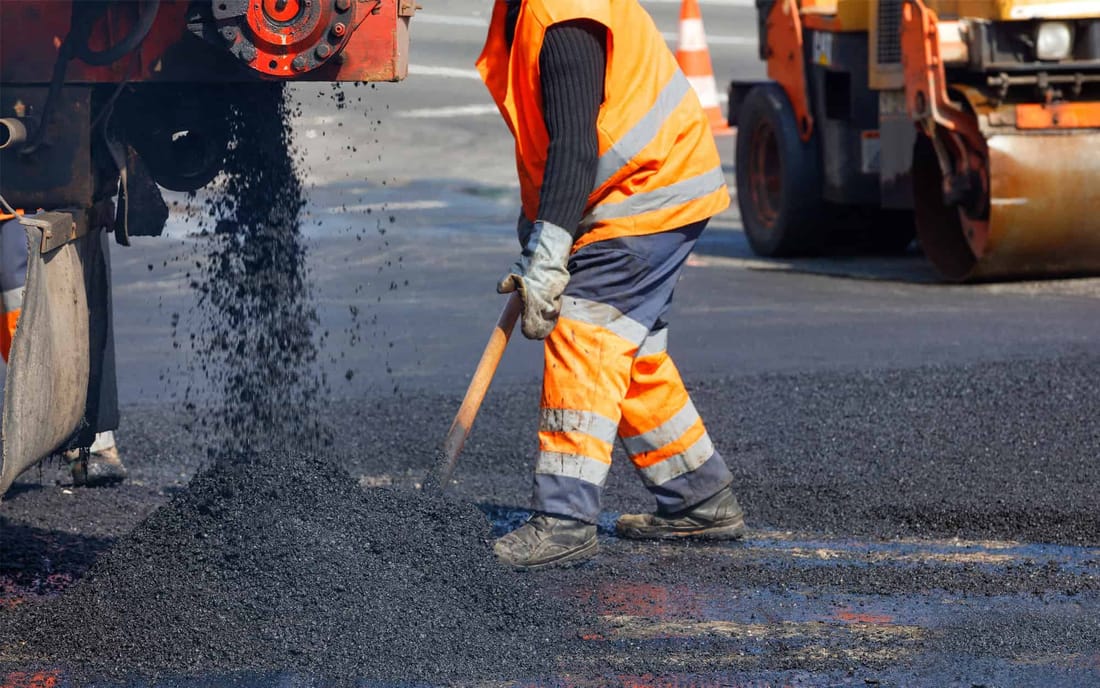
4. Asphalt placement: We usually install at least two asphalt lifts, a structural base course and a surface course. For very heavy-duty yards we may install an intermediate binder course as well. Each lift is placed with a paver, compacted immediately with vibratory and static rollers, and checked for density, smoothness, and thickness.
5. Detailing and transitions: Industrial sites often have joint lines between asphalt and concrete dock aprons, trench drains, or rails. We pay close attention to these interfaces to avoid differential settlement and trip hazards. Proper butt joints, saw-cut edges, and tie-in details extend pavement life and improve safety.
6. Final striping and protection: After cooling and curing, we add striping, markings, wheel stops, and bollard bases as needed. For facilities that must stay operational, we phase the work so access for trucks and staff is maintained while sections are completed and cooled.
What Drives Cost In Industrial Asphalt Paving Projects
Cost on an industrial asphalt paving project in Cleveland is driven much more by structure and logistics than by square footage alone. The main factors are:
Subgrade and drainage: Sites with soft, saturated soils or poor drainage need thicker base courses, undercuts, or underdrains. Around the Cuyahoga River and low-lying former industrial sites we often encounter fill materials and groundwater issues that must be addressed if you want the pavement to last.
Pavement thickness and mix design: Heavier truck traffic and higher expected ESALs (equivalent single axle loads) require thicker sections and industrial-grade mixes, which use more aggregate and binder. That adds material cost, but it prevents rutting and structural failure that can shut down operations.
Phasing and access: If your facility must remain operational, we may need to pave in stages, work nights or weekends, or build temporary access lanes. That additional mobilization and traffic control affects pricing but protects your shipping schedule.
Site complexity: Areas with many tight radii, drains, utility structures, and tie-ins to existing pavement require more handwork and careful compaction around obstructions. Open, unobstructed truck courts are more efficient to build and cost less per square foot.
When we price a project, Precision Asphalt Cleveland provides clear explanations for each cost driver so you can see where investing a bit more in structure or drainage now will save major rebuild costs later.
Common Industrial Pavement Problems We Solve In Northeast Ohio
Industrial pavements around Cleveland often suffer from the same underlying issues, and we design projects to prevent or correct them.
Rutting in wheel paths: Heavy trucks following the same lines into docks or gates can create ruts if the section is too thin or the mix is not stiff enough. We counter this by increasing base thickness, using stiffer base mixes, and reinforcing high-stress lanes with specialized mixes.
Pumping and potholes near catch basins: When water sits around structures and infiltrates the base, traffic can pump fines out and create voids that collapse into potholes. We address this with proper grade adjustments, tight collars around structures, stable base materials, and, if needed, new or re-set drainage structures.
Edge failures along pavement limits: Forklifts and trucks driving too close to unsupported edges can cause the edge to crack and unravel. On new projects we design pavement widths and edge support so wheel loads stay inside the structural section. On repairs we may widen lanes or add edge strengthening.
Fatigue cracking in storage yards: Long-term static loads from stored trailers, containers, or equipment can over-stress thin pavements. We design storage zones with thicker asphalt or combination sections that distribute those loads so the pavement does not fail prematurely.
What Cleveland Facility Owners Should Consider Before Hiring
Before you choose a contractor for industrial asphalt paving, it helps to clarify a few key points so you get a pavement tailored to your operation rather than a generic parking lot section.
Define your heaviest and most frequent loads: Know your truck types, axle weights, and turning areas. If you expect growth in traffic over the next 10 to 20 years, share that with us so we can design with that in mind.
Consider long-term maintenance access: Think about where you can phase repairs in the future without shutting down operations. We can design joints and section limits that make future overlay or reconstruction cleaner and less disruptive.
Plan around Cleveland's weather: The paving season here is limited. High quality industrial work requires appropriate temperatures and dry conditions. Schedule early where possible, especially for projects that must be completed before winter, and allow realistic cure and cool-down time before opening to full heavy traffic.
Ask about testing and documentation: For heavy-duty work we recommend density testing, material tickets, and as-built thickness records. Precision Asphalt Cleveland can provide these documents so your pavement structure is verifiable for lenders, insurers, and engineers.
By addressing these items up front with Precision Asphalt Cleveland, you get an industrial asphalt pavement that matches your real-world conditions in Cleveland, performs under your heaviest loads, and provides predictable life cycle costs instead of recurring emergency repairs.